
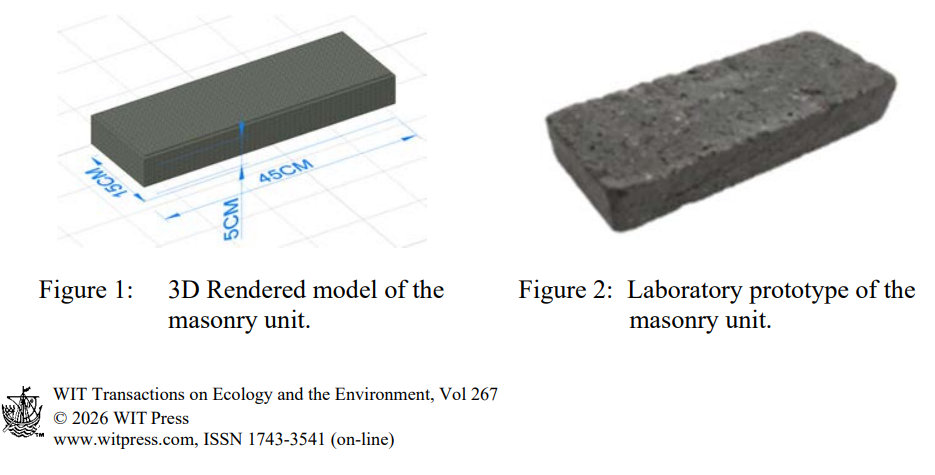
The construction industry in the Dominican Republic faces the challenge of reducing its dependence on conventional materials with a high environmental footprint, especially concrete. At the same time, the country generates large volumes of sugarcane bagasse as an agro–industrial residue whose use still offers significant opportunities for higher value-added applications. In this context, the research proposes producing eco-bricks by incorporating sugarcane bagasse as a partial substitute for conventional aggregates, within a circular-economy approach oriented toward environmental sustainability, technical feasibility, and economic profitability. The study was developed as a feasibility study in San Pedro de Macorís, Dominican Republic, considering raw material availability, market conditions, and applicable regulatory requirements. The proposal suggests partially replacing 10% of the aggregates with bagasse fiber while maintaining parameters compatible with non-structural uses. In addition, the model incorporates operational continuity strategies, such as seasonal bagasse storage and reincorporating rejected units into the production process, to strengthen system efficiency. The results show that the proposed alternative offers relevant technical, environmental, and economic benefits. From an environmental perspective, it achieves an estimated 7.21% reduction in CO2 emissions compared to a conventional mixture. Economically, the project is expected to achieve a benefit–cost ratio of 1.3, an internal rate of return above 81%, and a payback period of about 1 year. From a technical standpoint, the material has lower density and unit weight and performs well for non-structural applications. Using sugarcane bagasse in eco-bricks offers a viable alternative to promote sustainable innovation, create green jobs, and strengthen the transition to lower-impact construction models in the Dominican Republic.
Link para ver la publicación completa: https://bvearmb.do/handle/123456789/8212